Most homeowners think about their roof when something goes wrong: a leak, missing shingles, or damage after a storm. Ventilation rarely comes up until it causes a problem. But poor ventilation is one of the most common and preventable reasons roofs fail early, energy bills climb, and attic spaces become breeding grounds for moisture and mold.
Here is what roof ventilation actually does, how to know if yours is working, and what to do if it is not.
What Roof Ventilation Does
Your attic acts as a buffer zone between your living space and the elements. Without proper airflow, that buffer becomes a problem.
Ventilation keeps air moving through your attic by pairing intake vents (typically at the soffits or eaves) with exhaust vents (at or near the ridge). Cool outside air enters at the bottom and pushes hot or moist air out at the top. Simple in concept, but critical in execution.
A well-ventilated attic does three things:
- Regulates temperature so heat does not build up and damage shingles from the inside out
- Controls moisture so condensation does not rot your decking, rafters, or insulation
- Reduces strain on your HVAC system by keeping attic temps closer to outdoor temps
What Happens When Ventilation Fails
In summer, a poorly ventilated attic in the Charlotte area can reach 150 degrees or more. That heat radiates down into your living space, forcing your air conditioner to work harder. It also bakes your shingles from underneath, shortening their lifespan significantly.
In winter, warm air from inside your home rises into the attic. Without ventilation, it gets trapped and causes moisture to condense on cold surfaces. Over time, that moisture leads to:
- Wood rot in the decking and structural members
- Mold and mildew growth in the attic
- Degraded or compressed insulation that no longer performs
- Ice dams along the roofline (less common in Charlotte but not unheard of during cold snaps)
In both seasons, the damage happens slowly and out of sight. By the time it is visible, the roof repairs are more extensive than they would have been with proper airflow from the start.
Types of Roof Vents
Not all ventilation systems are the same. Here is a quick breakdown of what you might have or what might be recommended for your home:
Ridge vents run along the peak of the roof and allow hot air to escape along the entire length of the ridge. They are one of the most effective exhaust options and blend into the roofline without being visible from the street.
Soffit vents are the intake side of the equation. They sit under the eaves and draw in fresh air from outside. Ridge vents and soffit vents work as a system.
Gable vents are installed on the triangular end walls of the attic. They provide some airflow but are less consistent than ridge and soffit combinations because they depend on wind direction.
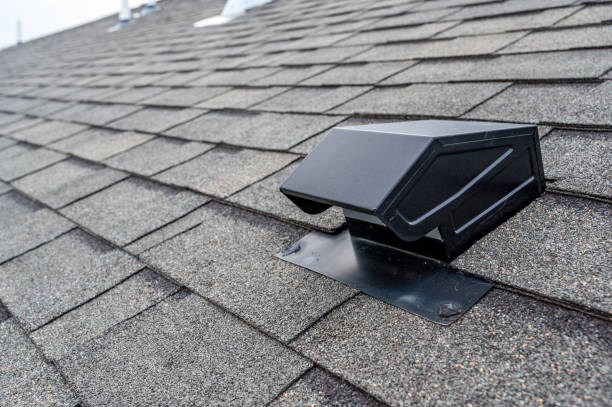
Roof louvers or box vents are individual exhaust vents installed at intervals across the roof. Effective when ridge venting is not possible, though less efficient overall.
Powered attic ventilators use a fan to actively exhaust hot air. They can be effective but also create negative pressure that may pull conditioned air out of the living space if the attic is not properly sealed from the home below.
How Much Ventilation Is Enough?
The general rule used in residential roofing is 1 square foot of net free ventilation area for every 150 square feet of attic floor space. If your attic has a vapor barrier, that ratio improves to 1:300.
Balance matters as much as volume. An attic with plenty of exhaust vents but blocked or inadequate soffit intake will not ventilate properly because there is no airflow path. The system has to work together.
This is one reason why a professional roof inspection matters. It is not just about counting vents. It is about understanding how air actually moves through your specific attic.
Signs Your Roof Ventilation May Be a Problem
You do not need to go into the attic to spot early warning signs. Look for:
- Unusually high energy bills, especially in summer
- Rooms on the top floor that are consistently harder to cool or heat
- Moisture or frost on attic surfaces in cold weather
- Visible mold or a musty smell coming from the attic
- Shingles that appear wavy, cracked, or aging faster than expected
- Soffit vents that are painted over or blocked by insulation
Any of these is worth a closer look before the problem compounds.
Ventilation and Your Roof Warranty
This is a detail homeowners often miss. Most shingle manufacturers, including Owens Corning and GAF, require adequate ventilation as a condition of the product warranty. If your roof is installed over an attic with poor ventilation and the shingles fail prematurely, the claim may be denied.
When TrueFrame Roofing replaces a roof, we assess ventilation as part of the process, not as an add-on. If something needs to be corrected, we will tell you upfront and explain why, so you are not losing warranty coverage the moment a new roof goes on.
Not Sure About Your Attic Ventilation?
A free roof inspection from TrueFrame includes a ventilation assessment. We will look at what you have, how it is performing, and whether any corrections make sense given your roof’s age and condition.
We serve homeowners throughout the greater Charlotte area, including Mooresville, Kannapolis, Concord, Statesville, Salisbury, and Harrisburg.
Call (704) 492-2016 or request a free inspection online. No pressure, no obligation, just a straight answer on what your roof needs.